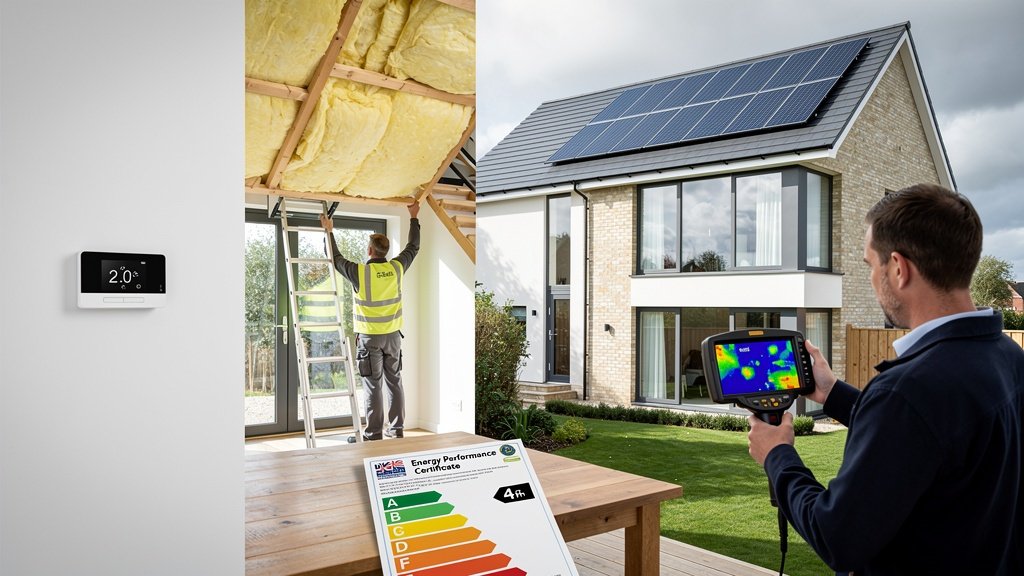
Energy bills have never been more front-of-mind for property buyers. As a Basingstoke surveyor, I've noticed a real shift in the conversations I have with clients — energy efficiency is now a genuine purchasing consideration, not just a box-ticking exercise. This guide explains how energy performance links to your building survey, what an EPC actually tells you, and what low ratings really mean for your running costs and future sale value.
The UK government has been clear that it intends to raise the minimum EPC rating required for rental properties over the coming years, and there is ongoing discussion about requirements for residential sales too. Regardless of regulation, buyers are increasingly aware that an energy-inefficient home costs more to run, is harder to keep warm, and may be harder to sell or remortgage in future. Understanding energy efficiency before you buy is simply good financial sense.
What Is an EPC and What Does It Actually Tell You?
An Energy Performance Certificate (EPC) rates a property's energy efficiency on a scale from A (most efficient) to G (least efficient). Every property sold or let in England and Wales must have a valid EPC, and they're publicly available on the government's EPC register. The rating is calculated using a Standard Assessment Procedure (SAP) and takes into account the construction, insulation, heating system, glazing and other factors.
Here's the important thing that many buyers miss: an EPC is a calculated estimate, not a measured result. It's based on the property's characteristics as recorded by an accredited energy assessor, but it doesn't measure actual energy consumption. A property with a good EPC rating can still have high bills if it's occupied in an energy-intensive way, and vice versa. The EPC is a useful benchmark, but it's only part of the picture.
The certificate also includes a list of recommended improvements and an estimate of how much each improvement would cost and save. This list can be genuinely useful — it tells you what the property needs to perform better, and gives you a starting point for planning upgrades after purchase.
What EPC Rating Should I Expect for Basingstoke Properties?
The typical EPC rating varies significantly depending on property type and age:
- New builds (post-2010) — typically B or C, often A with heat pumps and solar panels
- 1980s–2000s cavity wall, double-glazed homes — typically C or D
- 1930s–1970s semi-detached and terraced homes — typically D or E
- Victorian and Edwardian solid-wall properties — typically E or F, sometimes G if unimproved
- Thatched cottages and listed buildings — often F or G due to construction constraints
In Basingstoke, the housing stock is a mix of all of the above. The town's postwar estates typically rate in the D–C range, while the period terraces in the older parts of town often rate E or below. New developments on the outskirts typically achieve B or better.
How Does Energy Efficiency Feature in a Building Survey?
A RICS Level 3 Building Survey is primarily a structural and condition survey — it assesses the physical state of the building, not its energy performance in the way an EPC does. However, energy efficiency is woven into a thorough building survey in several important ways.
Insulation Assessment
We check what insulation is present and note any obvious deficiencies. In the loft, we look at the depth and condition of insulation — current best practice is 270mm of mineral wool, but many properties in Basingstoke have significantly less, particularly in older loft conversions. For cavity wall properties, we look for evidence of whether cavity wall insulation has been installed (typically evident from drill holes in the external brickwork that have been patched with mortar plugs).
Cavity wall insulation deserves a particular mention. Many properties in Basingstoke had cavity wall insulation installed under government grant schemes in the 2000s and 2010s. While properly installed cavity insulation is beneficial, incorrectly installed insulation — particularly in exposed locations or properties with existing defects — can actually cause or worsen damp problems by bridging the cavity and allowing moisture to cross from the outer to the inner leaf. Our survey will flag any concerns about cavity wall insulation and recommend specialist investigation where appropriate.
Glazing and Draught-Proofing
We note the glazing type throughout — single glazed, double glazed, or triple glazed — and comment on the condition of frames and seals. Failed double-glazed units (identifiable by misting or condensation between the panes) are extremely common and are worth noting as they reduce the thermal performance of the glazing significantly. We also note obvious draught issues — gaps around window and door frames, letterboxes without brushes, unused chimney flues without caps.
Heating Systems
We assess the type, age and visible condition of the heating system. A property with an old G-rated boiler — particularly an older floor-standing appliance — will have significantly higher running costs than one with a modern A-rated condensing boiler. We note the age and type of boiler, whether the heating controls are adequate, and the condition of radiators, pipework and hot water cylinder where visible.
The government's push toward heat pumps as a replacement for gas boilers is relevant here. Air source heat pumps are becoming more common in Hampshire, particularly in new builds and on properties that have had recent energy improvements. If you're considering a heat pump installation, bear in mind that they work most efficiently in a well-insulated property — a Victorian solid-wall house without adequate insulation is a poor candidate for a heat pump without insulation works first.
Thermal Imaging
Our thermal imaging survey service is a powerful addition to a standard building survey when you want a detailed understanding of a property's energy performance. A thermal imaging camera identifies areas of heat loss in real time — missing insulation, cold bridging, air leakage paths and failing double-glazed units all show clearly on a thermal image that standard visual inspection would miss. This is particularly valuable for Victorian solid-wall properties where the insulation picture can be complex.
The Real Cost of a Poor EPC Rating
A property rated F or G will cost significantly more to heat than an equivalent property rated C or D. The government's own estimates suggest that an F-rated home can cost £1,500–£2,500 more per year to heat than a C-rated equivalent, depending on size and occupancy. Over a 10-year ownership, that's a potential difference of £15,000–£25,000 in running costs — a figure that should absolutely factor into your purchase price negotiation.
Beyond running costs, there are implications for lending and future sale. Some lenders are beginning to factor EPC ratings into their lending criteria for buy-to-let properties, and this trend may extend to residential mortgages. A property with a very low EPC rating may attract a smaller pool of buyers when you come to sell, potentially affecting the sale price.
What Can You Do to Improve Energy Efficiency?
For most properties, there's a fairly clear hierarchy of energy improvements by cost-effectiveness:
Energy Improvement Priority Order
- Loft insulation — cheap, highly effective, DIY-possible. 270mm mineral wool is the standard. Typical cost: £300–£600 installed.
- Draught-proofing — excellent payback, low cost. Letterbox brushes, chimney balloons, door seals. Typical cost: £100–£300 DIY.
- Cavity wall insulation — effective for suitable cavity wall properties. Typical cost: £1,500–£2,500, often grant-funded.
- Boiler upgrade — replacing a pre-2005 boiler with a modern condensing boiler typically saves 15–20% on heating bills. Typical cost: £2,500–£4,000.
- Double glazing — replacing single glazed windows with good-quality double glazing. Typical cost: £5,000–£15,000 depending on property size.
- Solid wall insulation — for Victorian and older properties without cavities. Either internal (dry lining) or external render systems. Significant cost: £8,000–£25,000 but transformative impact on energy performance.
- Solar PV panels — good long-term payback, increasingly cost-effective. Typical installed cost: £5,000–£10,000 for a 4kW system.
- Heat pump — requires good insulation first. Typical installed cost: £8,000–£15,000 after government grant (BUS scheme).
The EPC vs The Reality: What Buyers Often Discover
One issue that comes up regularly in our surveys is a discrepancy between the EPC rating and the actual condition of the property's energy-related components. EPCs are assessed visually and rely on standard assumptions — an assessor cannot always verify what insulation is actually in the walls or the true condition of a boiler. We've surveyed properties with a D EPC where the loft insulation was completely absent, and properties with an E rating that actually had more insulation than the EPC assumed.
This is one reason why a building survey and an EPC are complementary rather than interchangeable. The EPC gives you the calculated rating; the survey gives you the actual condition on the ground. Both are valuable, and if there's a discrepancy, the survey finding should take priority in your planning.
Government Grants and Schemes Available in Hampshire
There are currently several government and local authority schemes that can help fund energy improvements to Basingstoke properties:
- Great British Insulation Scheme (GBIS) — funding for insulation measures for properties with EPC ratings D or below. Eligibility based on property type, EPC rating and household income.
- Boiler Upgrade Scheme (BUS) — £7,500 grant toward the cost of installing an air source or ground source heat pump. Applied via the installer.
- ECO4 scheme — energy company obligation scheme for low-income households and those on certain benefits. Covers a range of insulation and heating measures.
- 0% VAT on energy efficiency materials — insulation, solar panels and heat pumps are subject to zero VAT when installed professionally.
Your local authority — Basingstoke and Deane Borough Council — also periodically runs local area retrofit programmes. It's worth checking their website for current offers.
Frequently Asked Questions About Energy Efficiency and Surveys
Should I get a thermal imaging survey as well as a standard building survey?
For most modern properties in reasonable condition, a standard building survey is sufficient. For Victorian or solid-wall properties, or any property where you want a detailed picture of heat loss, a thermal imaging survey is a worthwhile addition. It costs around £200–£350 extra and can identify issues that standard inspection misses.
Can I use a poor EPC rating to negotiate on price?
Yes, absolutely. A property with an E or F rating will cost more to run than an equivalent C-rated property, and the cost of improvement works is real. You can legitimately present the cost of insulation, glazing upgrades and boiler replacement as a reason to negotiate the purchase price. Our survey report can help you quantify these costs.
Does improving the EPC rating increase property value?
Research consistently suggests yes — properties with higher EPC ratings sell for more than equivalent lower-rated properties. One Nationwide study estimated that moving from a D to a C rating adds around 3–5% to property value. In the current market, with energy costs so prominent, buyers are placing real value on lower running costs.
What if the property is listed and I can't install insulation?
Listed buildings are often exempt from minimum EPC requirements for lettings, and some energy improvement measures are restricted by the listing. However, there are still improvements available — secondary glazing (which doesn't affect original windows), improved heating controls, better hot water insulation, and some internal insulation methods that are appropriate for listed buildings. A specialist listed buildings surveyor can advise on what's feasible.
My mortgage lender is asking about the EPC rating — does this affect my application?
This is becoming more common. Some lenders have started offering preferential rates for properties above a certain EPC threshold (typically C), and others are beginning to flag very low-rated properties. If your lender has raised concerns about the EPC rating, speak with your mortgage broker and consider commissioning a thermal imaging survey to demonstrate you have a realistic improvement plan.
Want a Thermal Imaging or Energy-Focused Survey?
Our Basingstoke surveyors offer thermal imaging upgrades alongside all building surveys. Get a complete picture of what you're buying.
Get a Free Quote Learn About Thermal Imaging