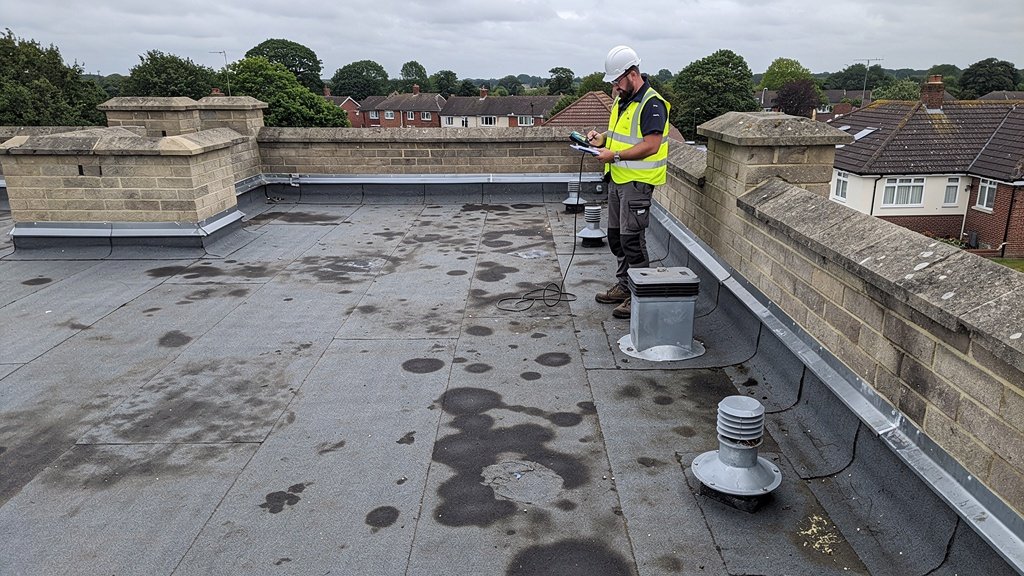
Extensions and flat roofs feature in a huge proportion of the properties we survey across Basingstoke and Hampshire — and they're consistently among the most problematic elements we find. This isn't because extensions are inherently bad, but because they're often built without proper planning, specification or workmanship. Here's what you need to know before you buy.
Flat Roofs: The Problem and the Solution
Flat roofs have an undeserved bad reputation. Modern flat roof systems — GRP (fibreglass), liquid applied membranes, EPDM rubber, or warm deck construction — can last 25–50 years with minimal maintenance. The problems arise with older systems — typically mineral felt roofs from the 1970s–1990s — which have limited lifespans and are prone to failure.
What We Check on a Flat Roof
- Covering condition — Is the felt or membrane intact, or are there blisters, splits or exposed areas?
- Ponding — Water pooling on a flat roof indicates inadequate falls. Even brief ponding accelerates covering deterioration.
- Upstands and flashings — Where the flat roof meets vertical surfaces (walls, parapets), the junction is sealed with upstands and lead flashing. Failed flashings are a primary source of water ingress.
- Drainage — Outlets must be clear and properly positioned. A blocked flat roof outlet can cause significant water ingress and structural damage.
- Parapet walls — On flat-roofed sections with parapet walls, we check coping stones for pointing and bedding, and ensure the roof itself drains away from the parapet rather than against it.
- Evidence of water ingress — In the room below the flat roof, we look for staining, damp or bowing to ceiling finishes.
What Flat Roof Repairs Cost
Costs vary enormously depending on the system and extent of work required:
- Patching a failing felt roof: £200–£600 (short-term solution)
- Full re-cover with new mineral felt: £1,500–£4,000 (depending on size)
- Upgrade to GRP or EPDM: £2,000–£6,000 (long-term solution, 25+ year lifespan)
- Flashing replacement: £300–£1,500
If a flat roof is at or near the end of its service life, we'll always flag this in our survey. A failing flat roof that isn't addressed will cause costly damage to the property below.
Extensions: What Can Go Wrong?
Extensions range from simple lean-to conservatories to large, multi-storey additions. The things we most commonly find wrong with extensions are:
Planning and Building Regulations Issues
Extensions require Planning Permission (unless permitted development rights apply) and, in most cases, Building Regulations approval. An extension without the required consents can be a legal and mortgage problem. We flag any extensions that appear not to have appropriate documentation, and recommend you instruct your solicitor to investigate.
Note: Permitted development rights were extended in 2020, so some larger extensions built since then may not have needed Planning Permission. Your solicitor will advise on this.
Structural Issues
Extensions need adequate foundations, properly designed steel beams over openings, and correct connections to the main structure. We've found: undersized steel beams causing deflection and cracking; extensions not properly connected to the main structure; and inadequate foundations causing differential settlement.
Thermal and Weatherproofing Issues
Where extensions abut the main structure, the junction between old and new is a common source of damp ingress. We also check that extensions meet current thermal insulation standards where applicable.
Loft Conversions
Loft conversions are extremely common in Basingstoke's housing stock, particularly in the semi-detached and terraced properties from the 1950s–1980s. Key concerns include:
- Structural adequacy — Did the conversion include proper structural engineering to support the floor and any dormer additions?
- Building Regulations compliance — Loft conversions must meet regulations including fire escape, floor loading and staircase requirements.
- Head height and habitable space — Not all loft conversions meet minimum habitable head height requirements (2.3m at ridge).
Always Verify Consents
If the property you're buying has an extension or loft conversion, always verify that the correct planning and building regulations consents were obtained. Your solicitor will request these as part of conveyancing. If consents are missing, indemnity insurance may be available — but it's better to know before you make an offer.
If you're buying a property with an extension, flat roof or loft conversion, a RICS Level 3 building survey is the appropriate choice. For a free quote from our Basingstoke surveying team, get in touch today.