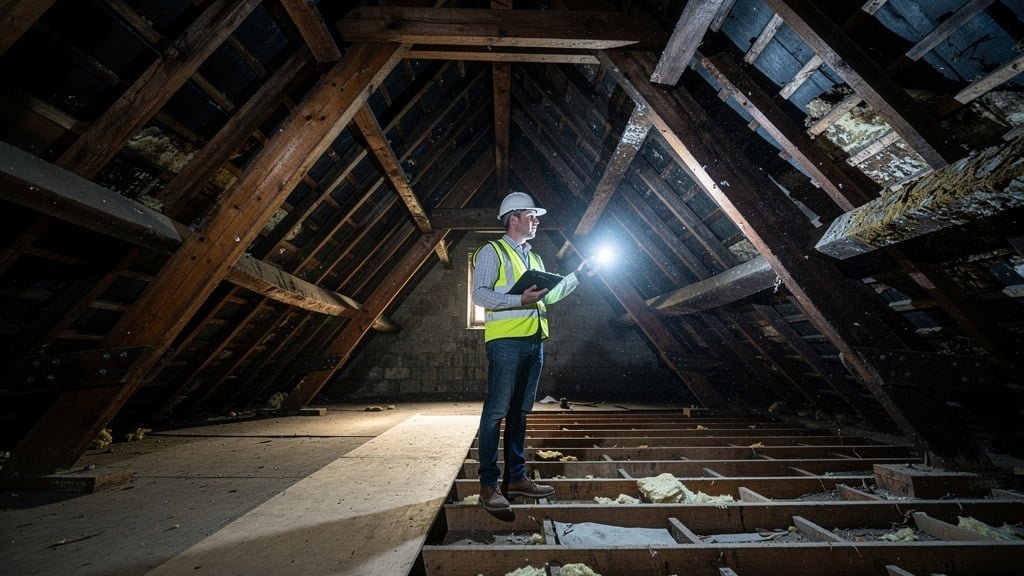
The roof is often the most expensive element of a property to repair or replace. It's also the element that gets the least attention on a casual viewing. On every survey we carry out across Basingstoke, the roof and loft space is one of our most important focus areas. Here's exactly what we look at — and what problems look like.
In 15 years of surveying properties across Hampshire, I've been in more lofts than I can count. Some are textbook perfect: well-insulated, properly ventilated, dry timbers. Others are concerning — visible daylight through gaps in tiles, rotten timbers, woodworm, insufficient insulation. Often, the state of the loft space tells you more about the true condition of the property than almost anything else.
The External Roof Inspection
We always start our roof assessment from the outside. Using binoculars and inspection from the ridge line where possible, we assess:
Roof Coverings
Plain clay or concrete tiles — Hampshire has a lot of both. We look for: cracked, slipped or missing tiles; moss and lichen growth (which can retain moisture and cause decay); nail fatigue (where tile fixing nails have corroded, causing tiles to slip); and lack of uniformity suggesting previous piecemeal repairs.
Slate roofs — Common on Victorian and Edwardian properties in Basingstoke town centre. We check for: delaminating slates (splitting); cracked or broken slates; slipped slates exposing felt or sarking below; and original nail fixings at the end of their lifespan.
Flat roofs — covered in detail in our related article: Flat Roofs, Extensions and Conversions: What Every Buyer Needs to Know.
Ridge and Hip Tiles
Ridge tiles are bedded in mortar at the apex of the roof. On older properties, this mortar often cracks and fails — sometimes dramatically, with ridge tiles becoming loose or falling away. Hip tiles (on hipped roofs) are similarly vulnerable. Failed ridge or hip tile bedding is a very common finding in our surveys of pre-1980 properties in Hampshire.
Chimneys
Chimney stacks are exposed to the weather from all sides and tend to deteriorate faster than the main roof. We look for: damaged or missing pointing (particularly on the flaunching — the mortar cap that seals the top of the stack); cracked or displaced chimney pots; lead flashings that have lifted or deteriorated; and staining suggesting water penetration into the stack.
Gutters and Rainwater Goods
Blocked, overflowing or leaking gutters are one of the most common causes of damp penetration in Hampshire homes. We check for: blocked gutters (particularly in autumn following leaf fall); gutters that are poorly graded (sagging and ponding rather than running freely to the downpipe); cast iron gutters that have split or corroded; and downpipes that aren't properly connected to the drainage system.
The Loft Space Inspection
Once we've assessed the roof externally, we access the loft space internally. This is where the story of the roof really unfolds.
Roof Timbers
We check the rafters, purlins, ridge board, ceiling joists and any trussed components for:
- Signs of active or historic water ingress — dark staining, rot, decay
- Woodworm (Furniture Beetle) — the most common timber pest in Hampshire homes
- Structural alterations — particularly conversions from cut timber to trussed rafters
- Sagging or deflecting rafters indicating overloading or inadequate support
- Damaged truss members (never cut without a structural engineer's approval)
Insulation
Current recommendations are for 270mm of mineral wool insulation between and over joists in an unoccupied loft. Many older properties have far less — sometimes none. Inadequate insulation is a significant heat loss issue and will affect your energy bills substantially.
Ventilation
Lofts need ventilation to prevent condensation forming on the underside of the roof covering. Without adequate cross-ventilation (usually via eaves soffit vents and/or ridge vents), moisture builds up, timbers become damp, and eventually rot and mould follow. This is a common finding in older retrofitted insulation schemes where insulation was pushed right to the eaves, blocking ventilation.
Signs of Daylight
On a sunny day, visible points of daylight through the roof covering (other than at intentional vents) indicate gaps where rain can enter. This needs addressing promptly.
What Roof Problems Cost to Fix
Roof repair costs vary enormously depending on the nature and extent of the problem:
- Re-pointing ridge or hip tiles: £800–£2,500
- Partial tile replacement (small area): £300–£800
- Full re-roofing (3-bedroom property): £8,000–£20,000+
- Chimney stack repair: £500–£3,000
- Gutter replacement (full run): £800–£1,500
- Insulation top-up: £300–£800
Don't Skip the Loft Access
We always access the loft if it's safe to do so. The single most important thing you can do to understand the condition of a property's roof is to get into the loft space and look at the timbers. This is standard practice in our Level 2 and Level 3 surveys — and it's one reason why instructing a thorough surveyor matters.
Ready to find out about the roof on your prospective new home? Contact our Basingstoke surveying team for a free quote on a RICS Level 2 homebuyer report or Level 3 building survey.